
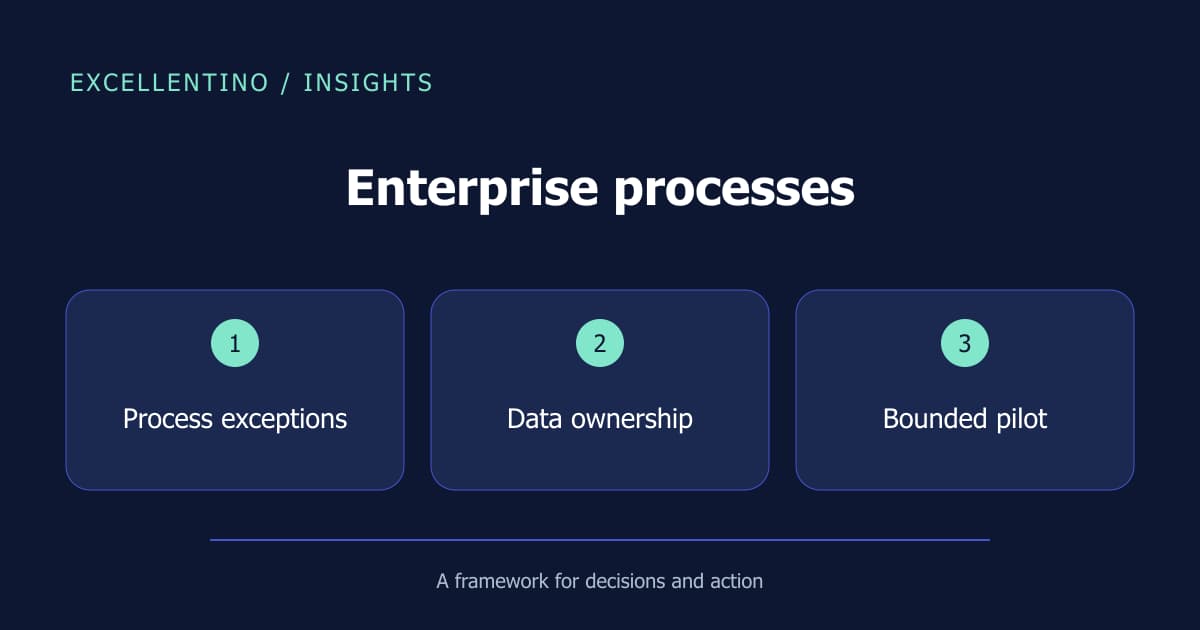
Define the management decision before choosing charts
A request for a sales dashboard does not yet define a deliverable. Establish who needs to act, when they need to act, and which change in the data should trigger that action. In a hypothetical example, a sales manager wants to find approved orders that have not shipped and assign follow-up. That is a different question from total sales for the month. This guide recommends limiting the first release to one decision, from source records through to a usable action. Choose charts, filters, and exports after that journey is clear.
- Write one decision statement: when the user sees a particular condition, what action follows?
- Specify the decision period, required detail, and whether users must inspect records behind a number.
- Separate reports needed at launch from ideas for subsequent releases.
Give each metric a definition and an approval owner
In the proposed brief, define sales through its formula, included document statuses, date basis, currency, returns treatment, and access boundaries. An order date may differ from an invoice date or the date cash is received; choosing between them is a business decision. For customers, products, invoices, and order status, record the authoritative system and correction owner. Tableau's governance guidance also assigns business and IT a shared role in defining controls for data and content. The allocation below is this guide's suggested starting point and requires agreement within your organization.
| Area | Decision to document | Approval owner |
|---|---|---|
| Metric meaning | Formula, included statuses, date basis, and unit | Finance or operational decision owner |
| Authoritative data | Creation and correction system and reconciliation identifier | System owner and data owner |
| Quality and discrepancies | Review method, correction route, and open-issue status | Business representative and data team |
| Definition changes | Definition version, historical impact, and effective date | Metric owner and report release owner |
Technical sources for this section: Tableau Blueprint Help [3]
Compare tools and delivery partners using the same scenario
A product name alone cannot establish fit. Ask each supplier to evaluate the same metric definition, permitted sample data, user role, and agreed exception. In this guide's comparison approach, classify each gap as configuration, integration, data cleansing, or custom development, and assign its maintenance owner. Scope estimates should cover more than licensing: include source connections, processing, infrastructure, user administration, training, and metric changes. Keep unknown costs visible rather than treating them as zero. The aim is a comparison of usable delivery responsibilities, not a ranking based on the longest feature list.
| Option to assess | When it merits investigation | Evidence before selection |
|---|---|---|
| Reporting in an existing tool | The source, definitions, and permissions may fit with limited changes | The same scenario working, with its limitations recorded |
| A BI platform with data integration | You need multiple sources, a shared model, or extensible reporting | A connection sample, reconciled metric, and role tests in the selected edition |
| Custom or hybrid reporting | Reporting forms part of a workflow or product with specialized rules | A user journey, API boundaries, and maintenance plan |
Make the final number traceable to its source records
For the proposed acceptance exercise, prepare a sample with expected totals approved by the metric owner. Include more than clean records: add a correction, cancellation or return, and an unmatched identifier where relevant to the agreed scope. Write down the expected treatment before the demonstration. When two reports disagree, first compare definitions, periods, ingestion times, and access filters; a visual adjustment should not conceal a discrepancy. If a discrepancy is accepted, document the permitted amount or boundary, its rationale, and the person authorized to accept it.
- Trace selected values from the metric to source documents and reference identifiers.
- Give missing, duplicate, or late records a detectable status and a review owner.
- Keep a reconciliation record with the definition version, sample, results, and open issues.
Test permissions using the user's actual role
Do not reduce permission acceptance to hiding a chart. The proposed matrix should cover report access, record detail, exports, and query creation. Microsoft's Power BI documentation states that workspace RLS applies to Viewers, but does not constrain Admins, Members, or Contributors. Metabase's documentation separately describes data permissions and collection permissions. These examples show why calling a dashboard private is insufficient. Test your chosen edition with actual authorized and unauthorized accounts, including the sharing and export routes your organization uses, and record the expected and observed boundaries.
- Include two users with different data scopes and one user without access in the acceptance sample.
- Write expected results for each role before testing, then record what actually happens.
- Assess permissions, export, and embedding in the edition and license included in the proposed contract.
Technical sources for this section: Microsoft Learn [1]Metabase Documentation [4]
Include freshness and failure behavior in the deliverable
Before requesting real-time reporting, define when the source changes and how much delay the decision can tolerate. Power BI's documentation explains that refresh requirements depend on the model's storage and connection approach: reloading imported data differs from querying a source directly. This guide recommends making the last successful ingestion time, covered period, and stale-data status identifiable in the report. During a controlled test, interrupt source access or refresh and observe how the operations owner detects the problem and responds. Choose freshness requirements from the business decision and source constraints.
- Agree acceptable staleness for each decision rather than imposing one threshold on every report.
- Do not treat a job execution timestamp as proof of the latest valid source data.
- Assign ownership for alerts, source-access investigation, and returning the report to a healthy state.
Technical sources for this section: Microsoft Learn [2]
Finish the pilot with evidence that can be reviewed
The proposed pilot has one decision, a limited metric set, named sources, and defined user roles. Agree its acceptance evidence before implementation so handover does not become a discussion limited to chart colors. The table is a working template, not a universal numerical threshold or contractual commitment. Record each result, supporting artifact, owner, and unresolved item. If a critical condition remains unmet, identify whether the gap lies in data, process, or tooling. Adding more reports does not by itself satisfy that condition or demonstrate readiness to expand.
| Suggested criterion | Exercise | Handover evidence |
|---|---|---|
| Metric meaning | Calculate a sample against the agreed definition | A versioned definition and metric-owner approval |
| Accuracy and traceability | Reconcile a sample and investigate an unmatched record | Reconciliation results and open issues |
| Access boundaries | View with authorized and unauthorized roles | A role matrix and observed test results |
| Freshness and failure | Check stale data and a controlled source interruption | Detectable status and a response route |
| Decision usability | Have the responsible user complete the scenario | An actionable outcome and recorded user feedback |
Resolve these questions before contracting and handover
Must all data be complete before starting? In the approach proposed here, a limited pilot can begin with a permitted sample and explicit scope, provided ownership, definitions, and data risks are understood. Synthetic samples do not establish behavior with real operational data. Is direct database access always preferable? That decision depends on freshness needs, source load, permissions, and the operating model, and requires validation in the selected environment. At handover, request model and source inventories, metric definitions, access and refresh instructions, acceptance results, a maintenance owner, and a process for changing definitions.
- Which files, models, settings, and usage rights will be handed over at the end of the engagement?
- Who investigates and releases changes when source structures or metric formulas change?
- Which costs recur, and which capabilities depend on a particular license?
- What new evidence and decisions are needed before expanding beyond the pilot?